_en_search_text
_en_search_text

Whether royal, academic, or museum-based, the library remains a treasure trove of knowledge and escapism. In late 18th-century Korea, in the Joseon Kingdom, King Jeongjo (r. 1776–1800) found in the contemplation of a painting depicting a library a way to remain symbolically surrounded by his books: a trompe-l’œil that extended the spirit of the study, stimulating virtue, curiosity, and scholarly conversation. Jeongjo then commissioned painters from the Royal Academy to create the first trompe-l’œil library paintings, which were installed in his study or even behind his throne. The Korean embassies in Beijing played a decisive role in this process. Joseon envoys discovered there the Chinese treasure cabinets, as well as the Jesuit art of perspective, which European artists had introduced at the Qing court and in the churches of the imperial capital. The fusion of Chinese scholarly tradition and European expertise in trompe-l’œil fueled the creativity of Korean painters, who developed a unique use of perspective known as chaekgeori.
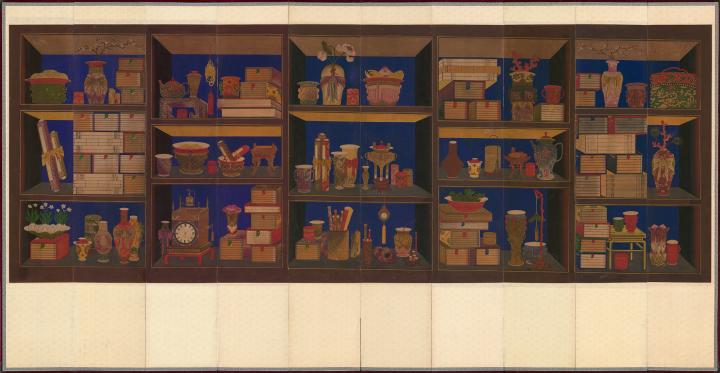
Ten-panel folding screen depicting a library, Korea, Joseon Dynasty (1392–1910), 19th century, ink, colors, and gold on silk, Seoul, National Museum of Korea © National Museum of Korea’s public work is used according to KOGL
This new art of books and objects quickly spread to palaces, aristocratic mansions, and homes across the provinces. Books, porcelain, archaic-style bronzes, writing instruments, and objects from China, Japan, or the West were gathered there in a skillfully crafted interplay of optical illusions. Far removed from European vanities, these painted libraries did not depict real collections, but rather a “cabinet of desires”—a vision of what one aspired to possess one day. Beginning in the late 18th century, books lost their scholarly value and became decorative; perspectives were shattered, forms distorted, and fantastical animals appeared. The library moved away from reality to enter a world halfway between surrealism, Fauvism, and dreamlike imagery.
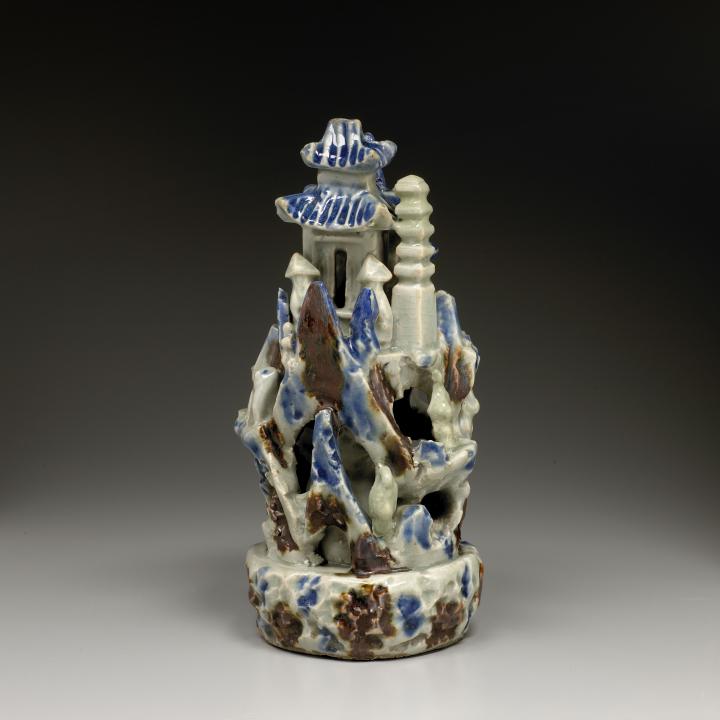
Inkstone and brush rest, Yi or Choson Dynasty, © Guimet Museum, Paris, Dist. GrandPalaisRmn / Image courtesy of the Guimet Museum
For the first time at the Guimet Museum, an exhibition restores this artistic movement to its rightful place, far from the folkloric or purely decorative image with which it is all too often associated. It draws connections between Jesuit art and Korean art, highlights the impact of Korean diplomatic missions at the Chinese court—notably through an exceptional 18th-century painted scroll measuring over five meters, on display for the first time—and reveals the spread of the codes of perspective through works from the Louvre and the Asian Civilisations Museum in Singapore. It also demonstrates that Joseon-era Korea was anything but a “hermit kingdom”, rather it was an open, curious country in constant dialogue with the world.
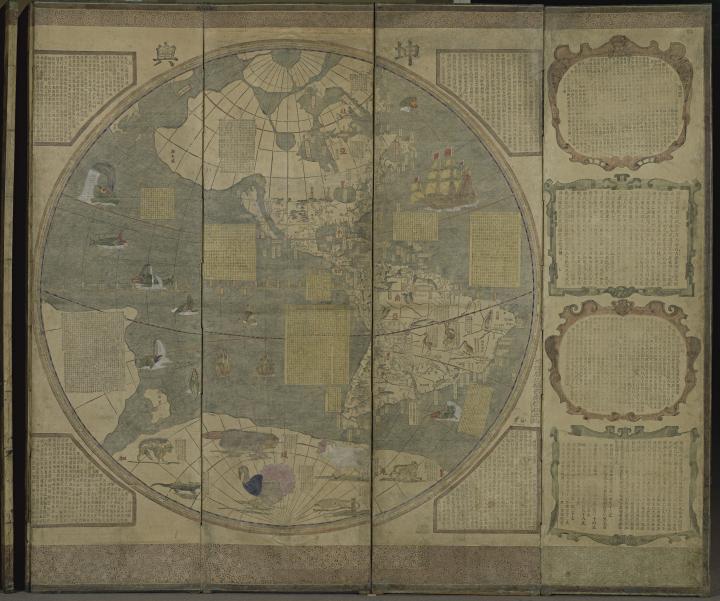
Eight-panel folding screen with a world map design (detail), Yi or Choson Dynasty, donation from Victor de Plancy, © Musée Guimet, Paris, Dist. GrandPalaisRmn / Thierry Ollivier
Curator:
Dr. Arnaud Bertrand, Former curator of the Korea and Ancient China Collections at the Guimet Museum