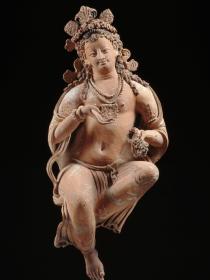
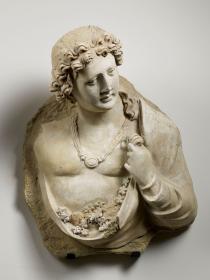
This youth holding flowers in a flap of his clothing, with his slightly bent head and three-quarters bust, is one of the emblematic Buddhist artworks of the site of Hadda in Afghanistan.
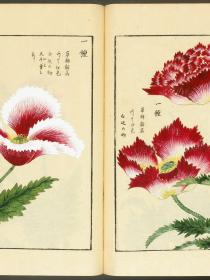
The Honzo zufu (Illustrated book of medicinal herbs) is a botany work owed to Iwasaki Tsunemasa (1786-1842), a Japanese botanist, zoologist, and entomologist, as well as a Samourai.
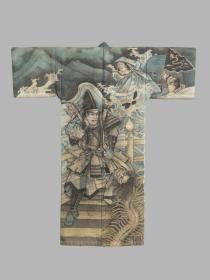
Firemen played a vital role in Edo Period cities regularly devastated by fires. The rudimentary material conditions of their interventions led them to be perceived as authentic heroes ready to sacrifice themselves for the community.
Under the reign of the Mughal emperor Akbar (1556-1605), Babur’s grandson, the Turko-Mongol-style costumes worn during the reigns of Babur and his son Humayun, unsuited for India’s climate, began to resemble traditional Indian garments.
This remarkably well-preserved helmet has kept its rear-peak, its throat piece, and is above all associated with its half-mask (mempo). On each of its wings It bears the Wakizaka family coat of arms.
The large horizontal “goggle eyes” of this statuette led it to be called “dogu with snow goggles”, their shape recalling the protections the Inuit population used against the reverberation of the sun on the snow. For others, they are closed eyelids involving these figures in the world of the dead.
This piece remains one of the most characteristic testimonies of the treasures of goldsmith’s art brought to light in this Silla kingdom (57 BC-668 AD).
One of the most emblematic scenes in the life of Buddha Shakyamuni is probably the one just before his Awakening, where the supreme deity of the world of desires, Mara, attempts to deter and then vanquish him.
Brought back by Paul Pelliot from the famous Chinese site of Dunhuang located at the start of the Silk Road, this painting represents a Buddhist mandala, or mystical diagramme. As often the case with esoteric works, this one requires being patiently deciphered.