
_en_search_text
_en_search_text

A beautiful early 20th-century Korean chaekgeori joins the Guimet Museum’s collections
Developed in the late 18th century under the impetus of King Jeongjo (reigned 1776–1800) to depict, in trompe-l’œil style, the objects of learning and luxury in the royal library, this trend has its roots in the art of rendering subjects in perspective, introduced to the Qing court in Beijing and the churches of the imperial capital by European artists. This new art of “books and objects” quickly spread to palaces, aristocratic residences, and provincial homes, intended to elevate the spirit and foster education. Books, porcelain, archaic-style bronzes, writing instruments, and objects from China, Japan, or the West accumulate there in a skillfully mastered interplay of optical illusions. Far from European vanities, these painted libraries do not depict real collections, but rather a cabinet of desires—what one aspires to possess one day.
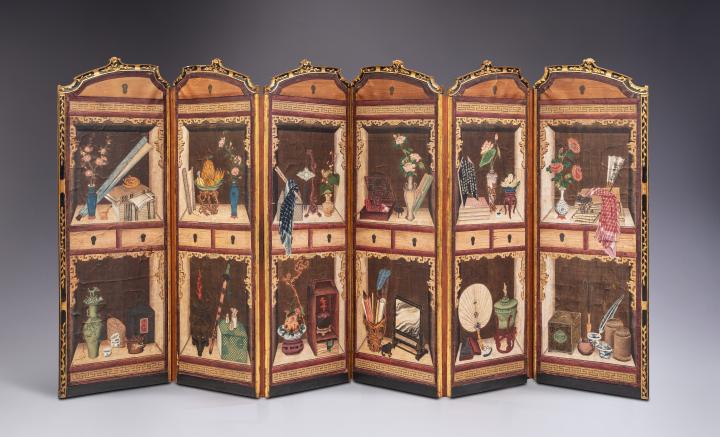
This painting, mounted on paper, is set on wooden panels accented with gold. On each panel of this imaginary trompe-l’œil library, the objects can be divided into three categories: treasures intended for the intellectual enrichment of its owner, material treasures, and exotic treasures from distant lands.
The artist skillfully played with the depth of the shelves to create the illusion that the linens, tied and held in place by a fan on one side and a bronze mirror on the other, appear to hang outside this library of treasures. This trompe-l’œil effect is accentuated by two drawers depicted from the front (while the shelves themselves are angled) on each panel. The objects on the shelves are clearly characteristic of Korea in the second half of the 19th century, a period during which exotic goods imported from distant lands were added to items traditionally sourced from China. The painted frieze with a Greek key pattern, as well as the gilded decorations imitating openwork woodwork, are characteristic of screens circulating between China, Vietnam, and Korea during this period.
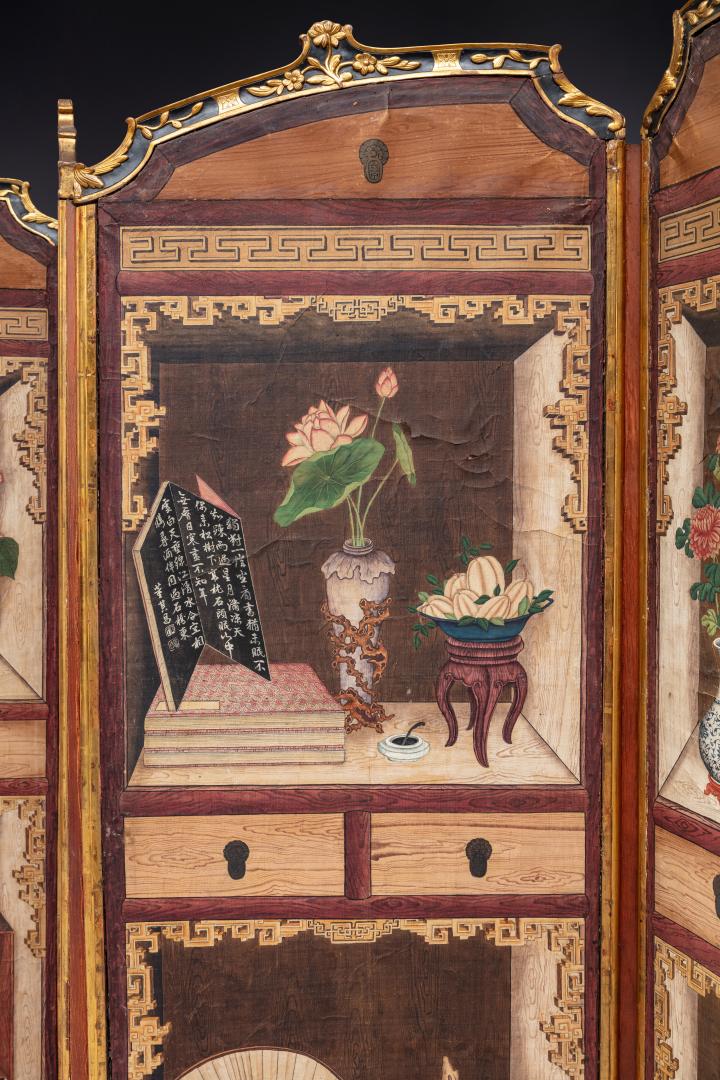
The painted panels have been reassembled—in an order that no longer appears to correspond to their original arrangement—onto an Oriental-style folding screen most likely made in France in the early 20th century. Divided into two sections, the structure features curved tops whose rocaille-inspired scalloped profile evokes a Neo-Louis XV style. To create visual continuity and reinforce the illusion of a cohesive whole, a new upper section, composed of painted panels, was added to adapt the works to the frame. The gilding, in a decorative style reminiscent of late 19th-century or Belle Époque Japanese-style screens, confirms European manufacture. Finally, the discreet hinges and the assembly of the panels are reminiscent of those found in Parisian workshops.
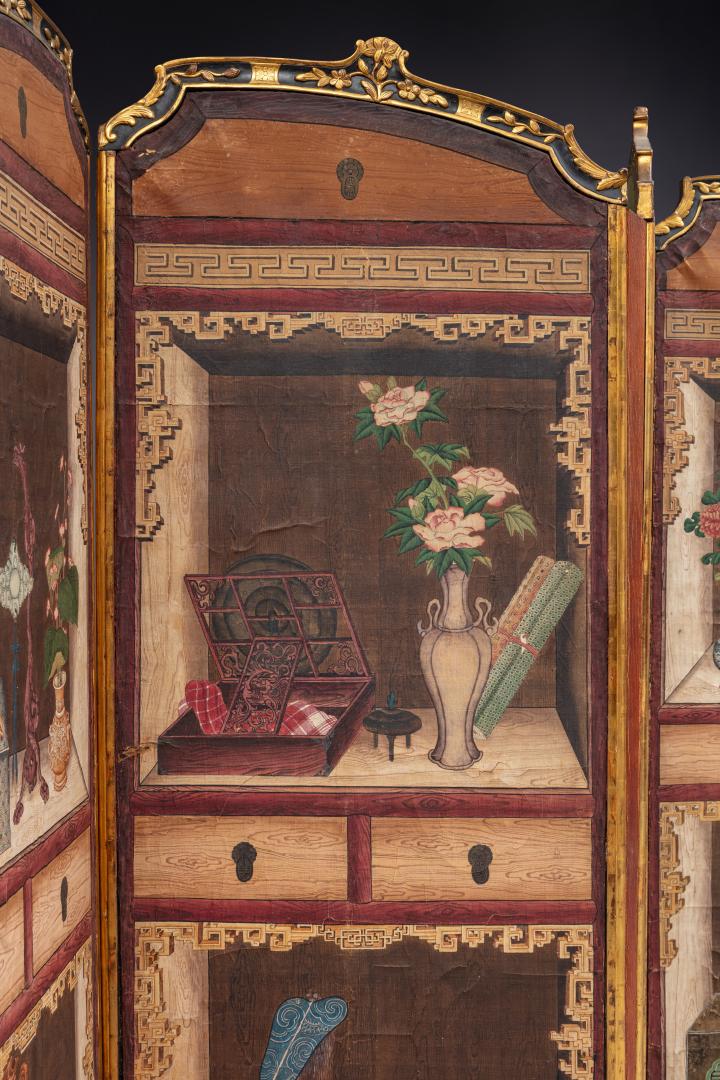
With its form and decoration, this screen—likely intended to be divided into two sections—fits perfectly into the aesthetic of Asian-inspired salons favored by noble and bourgeois interiors in France at the turn of the 19th and 20th centuries.