_en_search_text
_en_search_text

Revealed by archaeology as well as medieval chronicles, Silla art appears today as a living heritage at the heart of South Korea’s cultural memory. This unique presentation highlights a kingdom where, for nearly a millennium, art, spirituality and power combined to shape a culture of remarkable richness.
From the mythical origins of Silla, recounted in medieval Korean chronicles, to the fall of the kingdom, the exhibition unfolds in five thematic sections that trace the history, artistic expressions and memory of a state that was both powerful and deeply rooted in spiritual traditions. It offers a fresh perspective on this civilisation, revealing how political, religious and aesthetic dynamics intertwined to produce a legacy that has survived to this day.
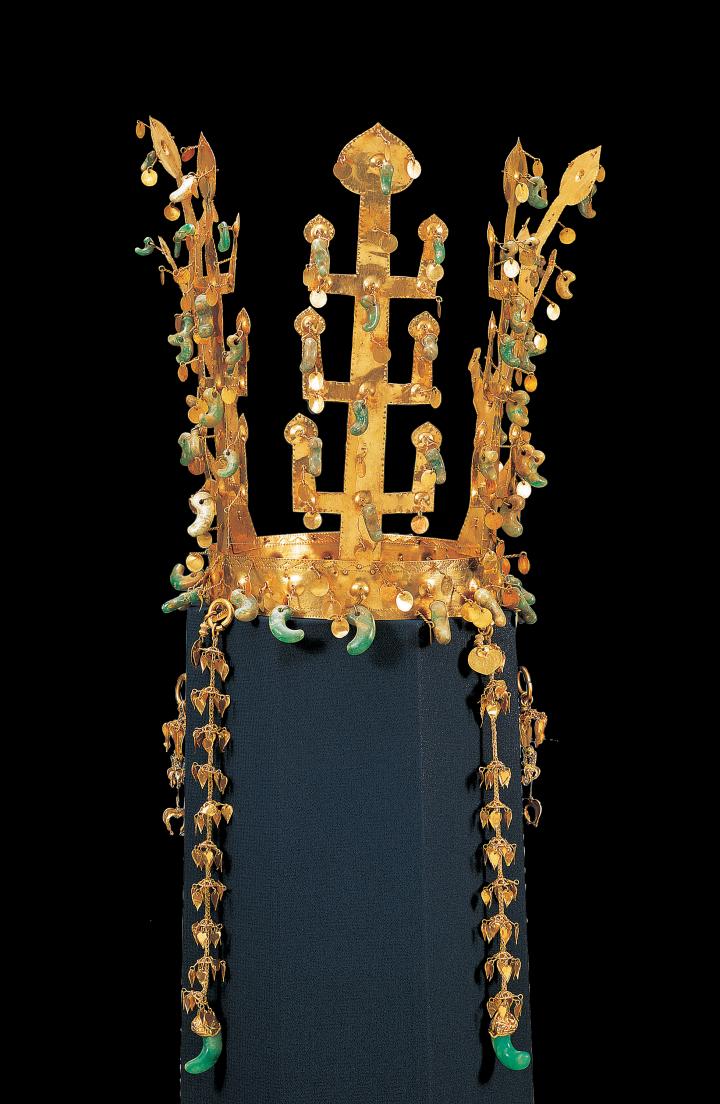
Gold crown, dangling pendants, and gold diadem ⓒ Gyeongju National Museum
Visitors will be transported back to the origins of the historic city of Gyeongju, in southeastern Korea, where they will discover the traces of a civilization whose legacy is still evident in the mountains, the immense “mountain tombs,” the temples, and modern life. It is a city whose residents are deeply committed to preserving their heritage.
From the 4th to the early 6th century, the period known as Maripgan marked a decisive stage in the affirmation of Silla’s identity with the rise of the Kim clan. Gold became the kingdom’s striking signature, a symbol of consolidated power. The treasures unearthed from the great royal tombs (gold crowns, jade ornaments, intricate jewellery, figurative sandstone) bear witness to exceptional craftsmanship and a kingdom open to trade along the routes connecting Japan, China, the steppes, Central Asia and even the Mediterranean world. Political prestige and artistic splendour merged, giving rise to a visual language of exceptional inventiveness.
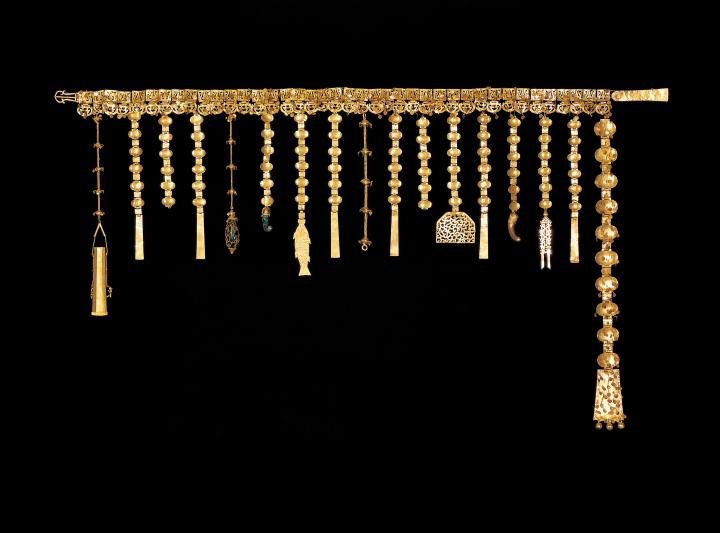
Gold belt and pendants ⓒ Gyeongju National Museum
During the Unified Silla period (676–935), the kingdom established itself as the dominant southern power, with Buddhism as the spiritual force and protector of the territory. Precious materials once reserved for royal tombs now found their way into monasteries, pagodas, reliquaries and sacred images. The treasures of iron, gold, silver, glass and stone from Silla constitute a living heritage, still visible in the landscape of Gyeongju and in the collective memory.
Nestled between wooded mountains and rolling plains, the city of Gyeongju, capital of Silla, still offers one of the most unique landscapes in South Korea. Pagodas, royal tombs and monumental ruins interact with the lines of a contemporary city that is careful to preserve its heritage. Visitors literally walk in the heart of history, in a space where the past remains visible, inhabited and transmitted.
Curators :
Dr Arnaud Bertrand, curator of the Korea – Ancient China collections at the Guimet Museum
Yim Jaewan, senior curator at the Gyeongju National Museum
Yun Seogyeong, assistant Curator at the Gyeongju National Museum